Tuesday, April 7, 2015

How to change and purge pumps

How to change solvent:
1. Start Chromeleon by double-clicking the icon below on the desktop

2. Right-click anywhere on Chromeleon to de-select "Monitor Only" and access HPLC functions. There should be no check-mark in front of "Monitor Only".


3. Set Eluent % of the pump to purge to 100%. For example, if pump B is to be purged, set B to 100% and press <return> key. 


4. Then click Purge On


5. The Purge On button is green when purge is in progress. It will run at 3 mL/min for 5 min.


Saturday, April 4, 2015

How to submit sample in toxtyper

How to use ToxTyper

1. Launch ToxTyper by clicking on toxtyper icon. 

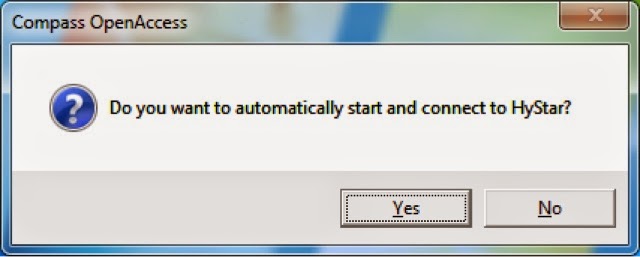
2. Answer "Yes" to "Start HyStar Automatically"


3. System access at Compass OpenAccess


4. Click on Queue Job(s)


5. Log in with user name and password then click "Next>". Now use demo.


6. Supply sample name (ID) and select Method for analysis (doa = drug of abuse, toxtyper = general, toxtyper QC = QC standard for instrument check)

7. Place sample vial on the specified position (R = Red, G = Green, B = Blue tray) , mark position and click Finish


8. The run will start 


Wednesday, April 1, 2015

Solvent Preparation for ToxTyper


Mobile Phase A (for 100mL):
  1. Water 97 mL
  2. ACN 1 mL
  3. 100 mM ammonium formate 2 mL
  4. Conc Formic acid 0.1 mL

Mobile Phase B (for 100mL):
  1. ACN 98 mL
  2. 100 mM ammonium formate 2 mL
  3. Conc Formic acid 0.1 mL

----------------------------------
Preparing 100mL of 100 mM ammomium formate
  1. Add 50 mL water to volumetric flask
  2. Add 381 uL of conc formic acid
  3. Add 747 uL of 25% ammonia
  4. Add water to make 100 mL
*** Rear Seal Wash solvent is 10 % MeOH

------------------------------------------------------
Calculation for preparing ammonium formate from ammonia and formic acid
1. formic acid density = 1.22 g/l
2. concentration in % = 98-100%
3. Molecular weigth = 46
Molar conc = 10*d*x/M = 10*1.22*99%/46 = 26.25 M

1. ammonia density = 0.91 g/l
2. concentration in % = 25%
3. Molecular weigth = 17
Molar conc = 10*d*x/M = 10*0.91*25%/17 = 13.38 M

For 100mL 100mM Ammonium formate (ratio = 1:1), use formic acid = 0.01 mol => 0.01 mol/26.25M = 0.381 mL; use ammonia = 0.01 mol => 0.01 mol/13.38M = 0.747 mL

Sunday, December 11, 2011

How to make nano-frit

http://www.abrf.org/index.cfm/list.msg/abrf/73705

Date: Mon, 10 Mar 2008 09:08:48 -0400
From: "J. Will Thompson"
To: "'ABRF Discussion List'"
Subject: RE: nano column frits

Hi Chris and Brian,

I have also used this material with a slightly different approach to make high-quality nanocolumn frits. Our technique uses Kasil 2130 (also available free in 1 liter), formamide, and a glass wool fiber filter. Make a clean cut on the end of the capillary and place the fiber filter on a hard surface like a lab benchtop. Place 20uL of Kasil 2130 on the glass filter. Pipet 20ul of formamide directly on top of the Kasil. Using gloves so you can grip the capillary well, depress the end of the capillary into the glass filter and rotate back and forth between thumb and forefinger. Lift and depress in a different spot on the wetted filter; repeat 15-20 times. Each time the capillary will make a small "hole" in the filter and the result should be a 0.5 to 1 mm frit in the end of the capillary (no need to trim the end of the capillary afterwards). Heat at 100C for 30 min to cure. I have used this to frit capillaries from 30 um to 150 um in diameter.
One note, the Kasil/formamide mix cures very quickly so use one spot on a filter paper per capillary you wish to frit. Since you are only using 20ul at a time, the free sample should give you about 50,000 capillary frits.

Good luck!

Will

J. Will Thompson, Ph.D.
Proteomics Core Facility
B02 Levine Science Research Center
Institute for Genome Sciences & Policy
Duke University Medical Center
will.thompson@duke.edu

Thursday, July 21, 2011

Direct comparison between automated biochemical technique vs MALDI-TOF based microorganism ID

Comparison between automated method and MALDI-TOF for the microbial identification is show clearly that MALDI is unbiased and accurate.

http://onlinelibrary.wiley.com/doi/10.1111/j.1469-0691.2010.03328.x/abstract;jsessionid=71A6CC99DA640BD80748EA58073939A5.d01t01

Combining with other crucial benefits, such as speed, simplicity, cost-effective, no consumables required, MALDI-TOF based microbial ID is a necessity in every microbiology lab.

Wednesday, July 6, 2011

Mascot Error at BIOTEC

The mascot database used at BIOTEC for years gave error complaining that it could not map memory for NCBInr.

Remove to check marks at the top of the database maintenance and configuration.

Also
IgnoreDuplicate EST_Other NCBInr